Navigating the complexities of business growth often requires expert guidance. But how do you choose between the distinct approaches of business coaching and mentoring? This exploration delves into the nuances of each, comparing their methodologies, benefits, and ideal applications for entrepreneurs and established businesses alike. We’ll uncover how these powerful tools can propel your business forward, highlighting the unique value proposition each offers.
Understanding the core differences between coaching and mentoring is crucial for making informed decisions about your professional development. While both provide valuable support, their focus, approach, and long-term impact differ significantly. This analysis will equip you with the knowledge to determine which path, or perhaps a combination of both, best suits your specific needs and business goals.
Defining Business Coaching and Mentoring
Business coaching and mentoring, while both offering valuable support for professionals, differ significantly in their approach, goals, and the types of clients they serve. Understanding these differences is crucial for individuals seeking professional development to choose the right path.
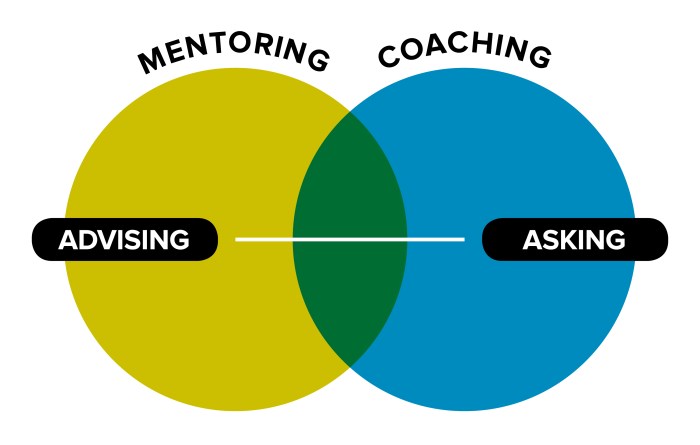
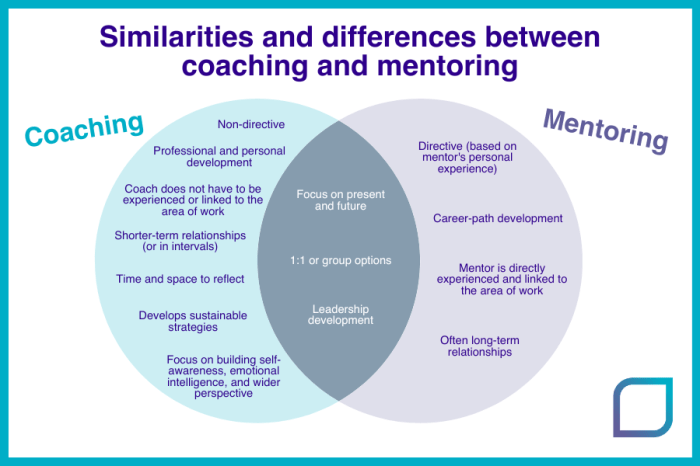
Both coaching and mentoring involve a relationship between a more experienced individual and someone seeking guidance, but their focuses and methods vary considerably. A key distinction lies in the timeframe and the nature of the support offered. Coaching is typically more focused, time-bound, and action-oriented, while mentoring is often a longer-term, more holistic relationship.
Business Coaching and Mentoring Roles
Business coaching focuses on specific, measurable goals and improving performance within a defined timeframe. The coach acts as a facilitator, guiding the client through a process of self-discovery and action planning to achieve pre-determined objectives. Mentoring, conversely, is a more relational and less structured approach. A mentor shares their experience, wisdom, and network to guide the mentee’s overall career development and growth, often over a longer period.
The mentor’s role is more advisory and less directive than that of a coach.
Typical Client Profiles
Business coaching often attracts individuals facing specific challenges, such as improving leadership skills, boosting sales performance, or navigating a significant career transition. These clients typically have a clear understanding of their goals and are actively seeking practical strategies to achieve them. Mentoring, on the other hand, often benefits individuals earlier in their careers or those seeking broader guidance on their career path and professional development.
Mentees may be less focused on immediate, tangible results and more interested in long-term growth and strategic navigation of their professional landscape. For example, a junior manager might seek a mentor for career advice, while a sales executive might hire a coach to improve their closing techniques.
Problem-Solving Approaches
Business coaches employ structured methodologies and tools to help clients identify problems, develop solutions, and track progress. They focus on actionable steps and measurable outcomes. Mentors, while offering guidance and advice, often encourage mentees to find their own solutions through reflection, exploration, and learning from experience. The mentor’s role is to provide insights and perspectives, rather than dictate solutions.
Types of Support Provided
Business coaches provide targeted support focused on achieving specific goals. This might include techniques such as goal setting, action planning, accountability, and feedback mechanisms. Mentors offer a broader range of support, including networking opportunities, advice on career strategies, exposure to different perspectives, and guidance on navigating organizational politics. A coach might help a client develop a sales strategy, while a mentor might introduce a mentee to key individuals within their industry network.
Comparison Table
| Feature | Business Coaching | Business Mentoring | Key Differences |
|---|---|---|---|
| Goal Focus | Specific, measurable, short-term goals | Broader career development, long-term goals | Coaching is targeted; mentoring is holistic. |
| Approach | Structured, action-oriented, directive | Advisory, supportive, less directive | Coaching is more structured; mentoring is more organic. |
| Timeframe | Short-term, project-based | Long-term, ongoing relationship | Coaching is time-bound; mentoring is open-ended. |
| Support Provided | Skill development, accountability, goal attainment | Guidance, networking, career advice, wisdom sharing | Coaching is performance-focused; mentoring is development-focused. |
The Value Proposition of Each Service
Both business coaching and mentoring offer significant value to business owners, but they approach growth from different angles. Coaching focuses on developing specific skills and strategies for immediate improvement, while mentoring provides broader guidance and long-term perspective based on the mentor’s experience. Understanding these distinct value propositions is crucial for choosing the right approach.
Business coaching delivers tangible benefits by providing structured support and accountability. It’s a highly focused approach that tackles specific challenges, offering practical tools and techniques to improve performance. Mentoring, on the other hand, offers a more holistic perspective, leveraging the mentor’s lived experiences to guide the mentee’s overall business development and strategic decision-making.
Tangible Benefits of Business Coaching
Coaching provides measurable improvements in various areas. A coach might help a business owner refine their sales strategy, resulting in increased revenue; improve their time management, leading to greater productivity; or develop a more effective leadership style, boosting team morale and performance. These improvements are often tracked through key performance indicators (KPIs), providing concrete evidence of the coaching’s effectiveness.
For example, a coach might work with a business owner to implement a new CRM system, resulting in a 15% increase in lead conversion rates within three months.
Examples of Successful Outcomes Achieved Through Mentoring
Mentoring often yields less immediately quantifiable, but equally impactful, results. A successful mentoring relationship might lead a business owner to identify and pursue a new market segment, resulting in long-term diversification and increased resilience. Or, a mentor’s guidance might help a mentee navigate a challenging period of rapid growth, avoiding common pitfalls and ensuring sustainable expansion. For instance, a seasoned entrepreneur mentoring a new business owner might prevent them from overextending their finances during a period of rapid growth, ultimately saving the business from potential failure.
Long-Term Impact on Business Growth
Both coaching and mentoring contribute significantly to long-term business growth, albeit in different ways. Coaching fosters immediate skill development and efficiency gains, leading to short-term wins that build momentum. Mentoring, on the other hand, equips the business owner with broader strategic thinking, improved decision-making, and a valuable network of contacts, setting the stage for sustained, long-term success. The combined effect of both approaches can be particularly powerful, creating a synergistic effect that accelerates growth.
Hypothetical Case Study: Business Coaching
Imagine a small bakery struggling with inconsistent sales. A business coach helps the owner analyze sales data, identify peak demand periods, and optimize inventory management. The coach also implements a targeted marketing campaign focusing on local social media and community events. Within six months, the bakery sees a 20% increase in sales and a 10% reduction in waste, directly attributable to the coaching intervention.
Hypothetical Case Study: Mentoring
Consider a tech startup experiencing rapid growth but facing challenges in scaling operations and managing a growing team. A mentor, a successful tech entrepreneur, guides the founder in developing a robust organizational structure, recruiting key personnel, and securing Series A funding. The mentor’s guidance helps the startup navigate potential pitfalls, ensuring sustainable growth and a successful exit strategy in the long term.
Potential Metrics for Measuring Success
Measuring the success of coaching and mentoring programs requires a multi-faceted approach. Key metrics might include:
Several metrics can effectively gauge the impact of coaching and mentoring initiatives. These metrics should be carefully selected based on the specific goals and objectives of each program.
| Metric | Coaching | Mentoring |
|---|---|---|
| Revenue Growth | Percentage increase in revenue | Percentage increase in revenue, market share expansion |
| Profitability | Improved profit margins | Improved profit margins, increased valuation |
| Customer Satisfaction | Improved customer retention rates | Improved customer loyalty, brand reputation |
| Employee Engagement | Increased employee productivity, reduced turnover | Improved team cohesion, stronger company culture |
| Operational Efficiency | Reduced operational costs, improved process efficiency | Streamlined processes, improved scalability |
Business Coaching and Mentoring in Specific Business Areas
Business coaching and mentoring offer distinct yet complementary approaches to improving various aspects of a business. Their applications span across numerous areas, significantly impacting business development, ethical practices, model refinement, and strategic planning. Understanding their specific roles within these contexts is crucial for business owners seeking growth and sustainability.
Business Coaching in Business Development
Business coaching plays a vital role in accelerating business development. Coaches work closely with entrepreneurs and managers, providing personalized guidance, accountability, and strategic insights to overcome challenges and achieve ambitious goals. This often involves identifying key performance indicators (KPIs), developing actionable plans, and implementing effective strategies for market penetration, sales growth, and operational efficiency. For example, a coach might guide a startup through the process of securing seed funding, helping them refine their pitch deck and navigate investor relations.
They might also help established businesses diversify their revenue streams or expand into new markets. The focus is on practical, results-oriented strategies tailored to the specific needs of the business.
Mentoring’s Enhancement of Business Ethics Practices
Mentoring provides a unique avenue for fostering strong business ethics. Experienced mentors, possessing established ethical frameworks and a wealth of practical experience, guide mentees in navigating ethical dilemmas and building a culture of integrity. This mentorship often involves sharing personal anecdotes, illustrating the consequences of unethical choices, and providing a sounding board for navigating complex ethical situations. For instance, a mentor might advise a mentee on the appropriate response to a potential conflict of interest or help them develop a robust code of conduct for their organization.
The value lies in the transfer of established ethical principles and the development of a strong moral compass within the business.
Coaching’s Role in Developing a Robust Business Model
Business coaching significantly contributes to the development of a robust and sustainable business model. Coaches assist in analyzing the business’s value proposition, identifying target markets, and defining key revenue streams. They help entrepreneurs explore different business models (e.g., subscription, freemium, transactional) and evaluate their suitability based on market dynamics and resource availability. A coach might guide a business through the process of lean startup methodology, encouraging iterative development and testing of the business model.
The ultimate goal is to create a model that is both profitable and resilient in the face of competitive pressures and market fluctuations.
Mentoring in Refining Business Strategy
Mentoring proves invaluable in refining a business strategy. Mentors, leveraging their experience and industry knowledge, offer insightful perspectives on market trends, competitive landscapes, and strategic decision-making. They help mentees critically evaluate their existing strategies, identify potential weaknesses, and develop alternative approaches. For example, a mentor might help a business assess the viability of a proposed expansion into a new geographic market or guide them in navigating a period of significant industry disruption.
The mentorship focuses on long-term strategic vision and adaptability in a dynamic business environment.
Business Travel Management: Coaching and Mentoring Compared
Both coaching and mentoring can improve business travel management, albeit in different ways. Coaching focuses on optimizing the efficiency of the travel process itself. A coach might work with a travel manager to streamline booking procedures, negotiate better rates with airlines and hotels, and implement travel policies that minimize costs and maximize employee productivity. Mentoring, on the other hand, emphasizes the strategic aspects of business travel.
A mentor might advise on the optimal frequency and purpose of business trips, helping the mentee make strategic decisions about which events to attend and which clients to visit. Both approaches contribute to effective travel management, but they address different aspects of the process: coaching focuses on the operational efficiency, while mentoring emphasizes the strategic alignment with broader business goals.
Integrating Business Coaching and Mentoring with Other Business Resources
Effective business coaching and mentoring aren’t isolated activities; they thrive when integrated with other crucial business resources. A holistic approach maximizes their impact, leading to more robust growth and improved outcomes. This section explores how coaching and mentoring synergistically support various aspects of business development, from securing funding to implementing innovative strategies.
By strategically integrating coaching and mentoring, businesses can leverage their combined power to achieve more significant and sustainable success. This integrated approach helps to create a cohesive and supportive environment for growth, aligning individual efforts with overall business objectives.
Business Coaching Support for Securing Business Loans
Business coaching significantly improves a company’s loan application success rate. A coach helps refine the business plan, strengthening its financial projections and demonstrating a clear understanding of market dynamics and risk mitigation. This process involves analyzing the financial statements, identifying areas for improvement in profitability and cash flow, and developing a compelling narrative that resonates with lenders. For example, a coach might help a small bakery owner refine their sales forecast based on seasonal trends and customer acquisition strategies, leading to more realistic and convincing projections in their loan application.
Furthermore, the coach can assist in preparing the business owner for the loan interview, enhancing their confidence and ensuring they can effectively communicate their business vision and financial strategy.
Mentoring Integration with Business Development Initiatives
Mentors provide invaluable guidance and support during various business development initiatives. Their experience helps navigate challenges, identify potential pitfalls, and accelerate the implementation of new strategies. For instance, a mentor with extensive experience in international trade can guide a startup seeking to expand into new markets, advising on regulatory compliance, cultural nuances, and strategic partnerships. Mentors also often provide access to their professional networks, opening doors to potential collaborators, investors, and customers.
This network effect can significantly accelerate the business development process, providing opportunities that might otherwise be inaccessible. The mentor’s wisdom helps avoid costly mistakes and provides a framework for sustainable growth.
Synergy Between Coaching and Implementing a New Business Model
Implementing a new business model requires significant change management and strategic execution. Coaching provides the structure and accountability needed to navigate this transition effectively. A coach helps the leadership team clarify their vision, develop a detailed implementation plan, and overcome internal resistance to change. Meanwhile, the mentor’s broad perspective offers insights into the long-term implications of the new model and potential market challenges.
Consider a company shifting from a traditional retail model to an e-commerce platform. A coach would guide the team through the process of website development, marketing strategy, and logistical adjustments, ensuring a smooth transition. The mentor, having navigated similar transformations, can offer critical insights into overcoming potential hurdles and adapting to the evolving market landscape.
Structured Approach to Integrating Coaching and Mentoring into a Comprehensive Business Strategy
Integrating coaching and mentoring requires a structured approach that aligns with the overall business strategy. This involves:
First, clearly defining the business goals and objectives. Then, identifying specific areas where coaching and mentoring can provide the most value. Next, selecting qualified coaches and mentors whose expertise aligns with the business needs. Finally, establishing clear expectations, timelines, and metrics for measuring the impact of these services. Regular review and adjustment of the approach are essential to ensure its ongoing effectiveness.
A well-defined budget should also be allocated to support these initiatives.
Flowchart: Business Coaching/Mentoring and Securing Business Loans
This flowchart illustrates the interaction between business coaching/mentoring and the process of securing business loans. It demonstrates how coaching and mentoring contribute to each stage, ultimately increasing the likelihood of loan approval.
The flowchart would visually represent the following stages:
- Business Idea/Need: The starting point, indicating the need for funding.
- Business Plan Development: This stage shows coaching and mentoring support in creating a robust and comprehensive business plan.
- Financial Projections: Illustrates the use of coaching to refine financial models and forecasts.
- Loan Application Preparation: Shows mentoring and coaching assisting in preparing a compelling loan application.
- Loan Application Submission: The point where the completed application is submitted to the lender.
- Loan Approval/Rejection: The outcome of the loan application process.
Arrows would connect these stages, demonstrating the flow of the process and the contribution of coaching and mentoring at each step. The flowchart would clearly show how a well-structured business plan, developed with coaching support, strengthens the loan application, leading to a higher probability of approval. It would also highlight how mentoring can provide valuable insights and connections that improve the overall application process.
Illustrative Examples
Real-world scenarios best demonstrate the distinct benefits of business coaching and mentoring. The following examples highlight how these approaches, individually and in combination, can drive significant business growth and employee development.
Business Coaching: Increased Sales Efficiency
A small e-commerce business was struggling with inconsistent sales performance. Their marketing efforts were scattered, and their sales team lacked a clear, structured approach. A business coach implemented a new sales process, focusing on targeted marketing campaigns and improved lead qualification. This involved training the sales team in effective communication techniques and sales pipeline management. Within six months, the business saw a 30% increase in sales conversion rates and a 15% overall increase in revenue.
The coach provided the structured framework and actionable steps, empowering the business owner to implement the changes effectively.
Mentoring: Strategic Partnership and Expansion
A bakery owner, struggling to scale her operations, was mentored by a seasoned entrepreneur with experience in franchising. The mentor provided guidance on developing a franchise model, securing funding, and managing the expansion process. This included advice on legal matters, marketing strategies for a larger market, and operational efficiencies for multiple locations. Over three years, the bakery expanded from a single location to five, with a significant increase in brand recognition and profitability.
The mentor’s experience and network proved invaluable in navigating the challenges of rapid growth.
Visual Representation: Coaching vs. Mentoring in Overcoming a Marketing Challenge
Imagine a bar chart. The X-axis represents time (months), and the Y-axis represents website traffic. The left side of the chart shows a line representing website traffic for a business facing a marketing challenge. The line initially shows a flat, low level of traffic, then a slight incline after implementing a marketing strategy on its own. A second line, representing the impact of business coaching, shows a steeper incline starting at the same point, showcasing a quicker and more significant increase in traffic.
A third line, representing mentoring, demonstrates a gradual but steady increase over a longer period, illustrating a different approach with slower but sustained growth. The visual clearly contrasts the speed and magnitude of impact between coaching and mentoring in addressing the marketing challenge. The coaching approach leads to rapid, short-term gains, while the mentoring approach fosters long-term, sustainable growth.
Impact on Employee Development
Business coaching and mentoring play complementary roles in employee development. Coaching focuses on skill enhancement and performance improvement through targeted training and feedback. Mentoring provides broader guidance on career progression, networking opportunities, and overall professional development. A well-rounded employee development program integrates both, providing employees with the tools and support they need to excel in their roles and advance their careers within the company.
This leads to increased employee engagement, retention, and overall organizational performance.
Leveraging Both: Navigating a Market Disruption
A restaurant owner faced a significant drop in customers due to a new competitor opening nearby. She engaged a business coach to help her refine her marketing strategy and improve operational efficiency. Simultaneously, she sought a mentor with experience in navigating market disruptions. The coach helped her implement targeted marketing campaigns and optimize her menu for profitability. The mentor provided strategic advice on adapting to the changing market landscape, exploring new partnerships, and identifying opportunities for differentiation.
By combining the practical strategies from the coach and the broader strategic vision from the mentor, the restaurant owner successfully weathered the competitive challenge and maintained its customer base.
Ultimately, the choice between business coaching and mentoring hinges on your individual needs and business context. While coaching provides a structured, goal-oriented approach focused on immediate improvements, mentoring offers a longer-term, relationship-driven perspective emphasizing wisdom and experience. Many successful businesses leverage both, creating a synergistic environment for sustained growth and development. By carefully considering the unique strengths of each, you can strategically incorporate these powerful tools into your business strategy for optimal results.
FAQs
What is the typical cost difference between coaching and mentoring?
Coaching generally involves a more structured, fee-based arrangement, while mentoring relationships can range from informal and unpaid to formal and compensated, depending on the mentor’s experience and the agreement.
How long does a typical coaching or mentoring engagement last?
Coaching engagements are often time-bound, lasting from a few months to a year or more, depending on the goals. Mentoring relationships tend to be more open-ended, evolving over a longer period.
Can I have both a coach and a mentor simultaneously?
Absolutely! Many business owners benefit from the combined support of both a coach (for focused skill development) and a mentor (for broader guidance and strategic advice).
How do I find a suitable coach or mentor?
Networking, online platforms, professional organizations, and referrals are excellent resources for identifying qualified coaches and mentors. Clearly define your needs and expectations before beginning your search.


