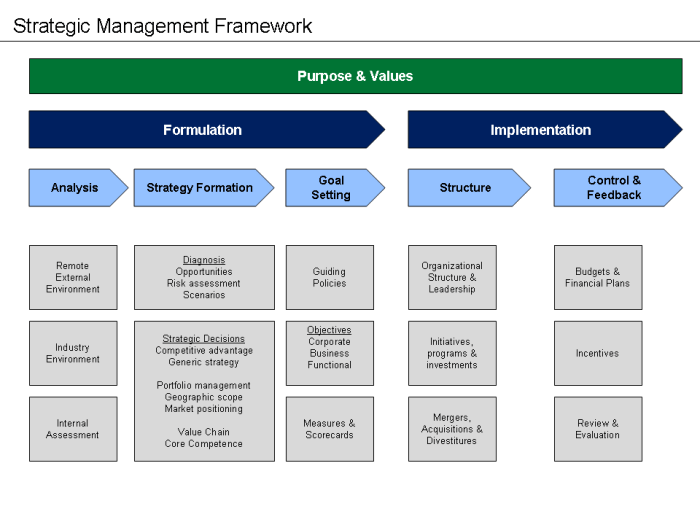
Strategic management frameworks are the bedrock of organizational success, providing a roadmap for navigating complex business landscapes. This guide delves into the core components of these frameworks, exploring various methodologies like Porter’s Five Forces and SWOT analysis, and demonstrating their practical application across diverse business contexts. We’ll examine the crucial interplay between strategic management and business development, ethical considerations, business coaching, and securing funding, illustrating how these elements converge to achieve sustainable growth and profitability.
From designing hypothetical frameworks for startups to analyzing the strategic plans of established companies, this exploration offers a practical and insightful perspective on how organizations can effectively leverage strategic management to achieve their objectives. The guide further highlights the importance of ethical considerations and the role of business coaching in refining strategic thinking and decision-making processes.
Funding and Strategic Management
Securing adequate funding is paramount to the successful execution of any strategic initiative. A well-defined strategy, however brilliant, remains unrealized without the financial resources to support its implementation. This section explores the crucial interplay between strategic management and securing business loans, examining various loan options and their impact on strategic planning, and illustrating how a robust business model underpins a company’s funding capacity.
Business Loans and Strategic Initiative Implementation
Business loans provide the necessary capital to fund strategic initiatives, allowing companies to expand operations, invest in new technologies, develop new products or services, and enter new markets. For example, a company aiming to implement a digital transformation strategy might require a loan to upgrade its IT infrastructure, train employees on new software, and develop a new online platform.
The availability of such funding directly impacts the speed and effectiveness of strategic implementation. Without sufficient capital, strategic goals may be delayed or even abandoned altogether.
Comparison of Business Loan Options
Several business loan options exist, each with its own terms, conditions, and implications for strategic planning. Term loans offer a fixed amount of capital over a specified period, providing predictability for budgeting and strategic forecasting. Lines of credit, on the other hand, provide flexible access to funds as needed, offering greater adaptability to changing market conditions and unforeseen strategic adjustments.
Small Business Administration (SBA) loans, backed by the government, often offer more favorable terms than conventional loans, making them attractive for businesses with limited credit history or collateral. The choice of loan type significantly impacts a company’s financial flexibility and its ability to adapt its strategy in response to evolving market dynamics. A company pursuing aggressive growth might opt for a line of credit, while a company focused on steady, predictable expansion might prefer a term loan.
Business Model and Funding Capacity
A company’s business model fundamentally influences its ability to secure funding. A well-defined, profitable business model, clearly demonstrating a path to revenue generation and sustainable growth, is highly attractive to lenders. Investors and lenders are interested in businesses with a clear understanding of their target market, a competitive advantage, and a scalable business model. A strong business model reduces the perceived risk associated with lending, leading to better loan terms and increased access to capital.
Conversely, a poorly defined or unsustainable business model will likely make it difficult to secure funding, regardless of the company’s strategic vision. For instance, a business with a recurring revenue model, like a subscription service, is generally considered less risky and more attractive to lenders than a business with a highly variable revenue stream.
Financial Model: Impact of Strategic Decisions
The following financial model demonstrates how strategic decisions impact profitability and loan repayment capacity. This example assumes a hypothetical company implementing a new marketing strategy. The model projects revenue and expenses over a three-year period. Note that these are simplified projections and actual results may vary.
| Year | Revenue | Expenses | Profit |
|---|---|---|---|
| 1 | $500,000 | $400,000 | $100,000 |
| 2 | $750,000 | $450,000 | $300,000 |
| 3 | $1,000,000 | $500,000 | $500,000 |
This model illustrates how a successful strategic initiative (in this case, the new marketing strategy) can significantly increase profitability, thereby enhancing the company’s ability to repay its loans and attract further investment. A decrease in profitability, on the other hand, would negatively impact loan repayment capacity and potentially lead to financial distress. The success of the strategic initiative is directly linked to the financial health and stability of the business.
Strategic Management and Business Travel
Business travel, often viewed as an expense, is a crucial component of effective strategic management. It directly impacts the implementation of strategic initiatives, fostering collaboration and communication that drive organizational success. Understanding how to leverage business travel strategically, while maintaining cost-effectiveness, is vital for achieving organizational goals.Strategic initiatives often necessitate face-to-face interactions, which business travel facilitates. This is particularly true for complex projects, negotiations, and relationship building, where nuances of communication and trust are paramount.
Efficient business travel management ensures that these critical interactions occur seamlessly, contributing to the successful execution of strategic plans.
Business Travel’s Role in Strategic Initiative Implementation
Business travel plays a vital role in implementing strategic initiatives by facilitating direct communication and relationship building with key stakeholders. For instance, launching a new product in a foreign market requires on-site visits to meet with distributors, potential customers, and local teams. Negotiating a significant merger or acquisition necessitates in-person meetings to discuss complex legal and financial details, fostering trust and understanding among leadership teams.
Similarly, establishing strategic partnerships often benefits from face-to-face discussions to align goals and establish working relationships. Without these in-person interactions, the success of these strategic initiatives would be significantly hampered.
Strategic Decisions’ Influence on Business Travel Needs
Strategic decisions directly shape the need for business travel. For example, a company expanding into new geographical markets will inevitably see an increase in business travel for market research, site selection, and team building. A company focusing on cost reduction might implement stricter travel policies, opting for video conferencing where feasible. The launch of a new product line might necessitate frequent trips for sales training and customer demonstrations.
Conversely, a shift towards a remote work model might significantly reduce the overall need for business travel. The strategic direction of the company inherently dictates the frequency, purpose, and scope of business travel.
Managing Business Travel Costs While Maintaining Strategic Objectives
Effective management of business travel costs is crucial. This involves implementing robust travel policies, negotiating favorable rates with airlines and hotels, and leveraging technology for efficient booking and expense management. Companies can utilize travel management platforms that offer real-time tracking and reporting, enabling better control over spending. Prioritizing cost-effective travel options, such as utilizing budget airlines or choosing accommodations that offer value for money, is also essential.
However, it’s vital to balance cost savings with the strategic need for face-to-face interactions. Sometimes, the cost of a missed opportunity due to the absence of in-person interaction far outweighs the cost of the travel itself.
Business Travel’s Contribution to Improved Communication and Collaboration
Effective business travel significantly improves communication and collaboration. Face-to-face meetings allow for richer, more nuanced communication, reducing misunderstandings and fostering stronger relationships. Team-building activities conducted during business trips can enhance collaboration and improve team cohesion. Furthermore, informal interactions during travel can lead to the generation of innovative ideas and solutions. The shared experiences during business travel contribute to a stronger sense of team identity and shared purpose, which are essential for the successful implementation of strategic initiatives within a strategic management framework.
Illustrative Example: A Strategic Plan for NovaTech Solutions
NovaTech Solutions is a fictional company specializing in developing innovative software solutions for the education sector. This strategic plan Artikels the company’s mission, vision, goals, and strategies for achieving sustainable growth and market leadership. It details the target market, competitive landscape, key resources, marketing and sales strategies, and operational and technological plans.
Company Mission, Vision, and Goals
NovaTech Solutions aims to revolutionize the educational experience through cutting-edge technology. Our mission is to empower educators and students with intuitive, engaging, and effective software solutions that enhance learning outcomes. Our vision is to be the leading provider of educational technology solutions globally, recognized for our innovation and commitment to educational excellence. Our primary goals include achieving a 20% market share within three years, expanding into three new international markets within five years, and maintaining a customer satisfaction rating of 90% or higher.
Target Market and Competitive Landscape
NovaTech Solutions’ target market consists of primary and secondary schools, colleges, and universities, both public and private, globally. Our primary competitors include established educational technology companies such as Blackboard and Moodle, along with several smaller, niche players. The competitive landscape is characterized by rapid innovation, increasing demand for personalized learning experiences, and a growing emphasis on data-driven decision-making in education.
Key Strategic Decision 1: Focus on developing personalized learning platforms with advanced analytics capabilities to differentiate from competitors.
Key Resources and Capabilities
NovaTech’s key resources include a highly skilled team of software developers, designers, and educators, a robust technology infrastructure, and strong intellectual property. Our core capabilities lie in our ability to design user-friendly interfaces, integrate data analytics into our products, and provide excellent customer support.
Marketing and Sales Strategies
Our marketing strategy will focus on digital marketing, including search engine optimization (), social media marketing, and content marketing, targeting educators and administrators. We will also leverage industry events and partnerships to increase brand awareness. Our sales strategy will involve direct sales to institutions, as well as partnerships with educational distributors.
Key Strategic Decision 2: Invest heavily in digital marketing and content creation to build brand awareness and generate leads.
Operations and Technology Plans
NovaTech will utilize agile development methodologies to ensure rapid product iteration and responsiveness to market demands. We will invest in cloud-based infrastructure to ensure scalability and reliability. Our technology plan includes continuous improvement of our software platforms, incorporating user feedback, and exploring emerging technologies such as artificial intelligence (AI) and augmented reality (AR) to enhance the learning experience.
This includes regular updates and security patches to ensure data privacy and platform stability.
Financial Projections
NovaTech projects significant revenue growth over the next five years, driven by increased market share and expansion into new markets. We anticipate a positive cash flow within two years, enabling reinvestment in research and development and further expansion. Our financial model is based on conservative estimates of market growth and customer acquisition costs, taking into account potential fluctuations in the educational technology market.
This includes contingency plans for economic downturns or unforeseen challenges in market penetration.
Ultimately, a robust strategic management framework is not merely a theoretical construct; it’s a dynamic tool that empowers organizations to anticipate challenges, capitalize on opportunities, and navigate the ever-evolving business environment. By integrating ethical considerations, leveraging business coaching, and securing appropriate funding, companies can effectively implement strategic initiatives, achieve sustainable growth, and build a strong foundation for long-term success.
This guide provides a comprehensive overview of the key elements involved, equipping readers with the knowledge and insights needed to effectively implement and manage their own strategic frameworks.
FAQ Explained
What is the difference between strategic and operational planning?
Strategic planning sets the long-term direction of an organization, while operational planning focuses on the short-term actions needed to achieve those strategic goals.
How often should a strategic management framework be reviewed?
The frequency of review depends on the industry and organizational context, but annual reviews are common. More frequent reviews may be necessary in dynamic environments.
What are some common pitfalls to avoid when implementing a strategic management framework?
Common pitfalls include insufficient stakeholder involvement, lack of clear goals and metrics, inadequate resource allocation, and failure to adapt to changing circumstances.
How can I measure the effectiveness of my strategic management framework?
Effectiveness can be measured by tracking key performance indicators (KPIs) aligned with strategic goals, conducting regular performance reviews, and soliciting feedback from stakeholders.