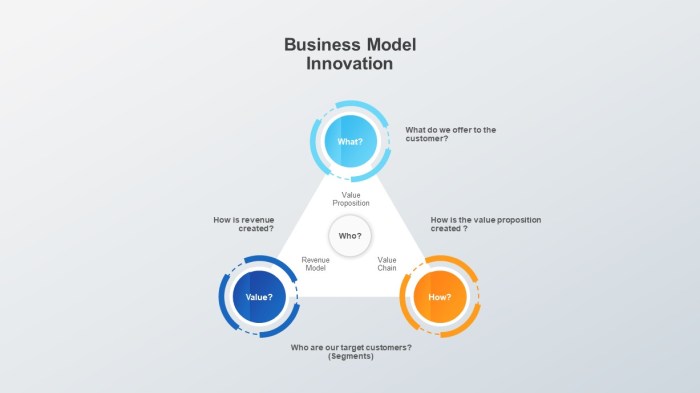
In today’s rapidly evolving marketplace, the ability to innovate a business model is no longer a luxury but a necessity for survival and growth. Companies that successfully adapt and reinvent their approaches to value creation, delivery, and capture often outpace their competitors. This exploration delves into the core principles of business model innovation, examining successful strategies, analytical frameworks, and practical implementation steps.
We’ll explore various approaches, from disruptive innovation that challenges existing market structures to architectural innovation that refines and improves existing models. We will also analyze the critical components of a successful business model, including value proposition, customer segments, and revenue streams, providing a structured framework for assessment and improvement. The discussion will also touch upon the ethical considerations, financial aspects, and the role of effective communication in successful implementation.
Analyzing Existing Business Models
Understanding and analyzing existing business models is crucial for identifying opportunities for innovation and improvement. A thorough analysis allows businesses to pinpoint strengths, weaknesses, and areas ripe for disruption or enhancement, ultimately leading to increased profitability and market competitiveness. This process involves a systematic examination of key components and a structured assessment of their effectiveness.Analyzing a company’s existing business model requires a deep dive into its core components.
This isn’t just about looking at the current state; it’s about understanding the underlying logic and assumptions that drive the model. Only then can meaningful improvements be identified and implemented.
Key Components of a Successful Business Model
A successful business model typically incorporates several key elements that work together synergistically. Understanding these components and their interrelationships is fundamental to a robust analysis.
- Value Proposition: This defines the value offered to customers. It addresses the problem solved, the benefits provided, and why customers should choose this specific offering over alternatives. A strong value proposition is clear, concise, and resonates with the target audience. For example, a subscription-based streaming service might offer a vast library of on-demand content at a lower cost than purchasing individual movies or shows.
- Customer Segments: This defines the specific groups of customers the business aims to serve. A successful business model often targets specific customer segments with tailored offerings and messaging. For instance, a luxury car manufacturer might target high-net-worth individuals, while a budget airline might focus on price-sensitive travelers.
- Revenue Streams: This Artikels how the business generates revenue. Revenue streams can be diverse, including subscriptions, advertising, licensing, transactional sales, and more. A successful business model often diversifies its revenue streams to mitigate risk and increase resilience. A software company might generate revenue through both licensing fees and subscription-based access to software updates and support.
- Channels: This describes how the business reaches its customer segments. Channels can include online platforms, retail stores, direct sales, and partnerships. Effective channels ensure that the value proposition reaches the target audience efficiently and effectively. An online retailer might use social media marketing and email campaigns to reach potential customers, while a brick-and-mortar store relies on foot traffic and local advertising.
- Customer Relationships: This Artikels how the business interacts with its customers. This can range from self-service to dedicated personal assistance. Strong customer relationships foster loyalty and repeat business. A SaaS company might offer extensive online documentation and community forums for self-service support, while a high-end jewelry store might provide personalized consultations and after-sales service.
- Key Activities: These are the essential activities the business undertakes to deliver its value proposition. Key activities can include product development, marketing, sales, and customer service. A fast-food restaurant might focus on efficient food preparation and quick service, while a consulting firm emphasizes strategic planning and client interaction.
- Key Resources: These are the assets required to deliver the value proposition. Key resources can include physical assets (equipment, facilities), intellectual property, human capital, and financial resources. A manufacturing company might require specialized machinery and skilled labor, while a software company relies on its codebase and developer talent.
- Key Partnerships: These are the relationships with external parties that contribute to the business model. Key partnerships can include suppliers, distributors, and strategic alliances. A car manufacturer might partner with parts suppliers and dealerships, while a technology company might collaborate with other tech firms to integrate their products or services.
- Cost Structure: This Artikels the costs incurred in operating the business. Understanding the cost structure is critical for profitability. A low-cost airline might prioritize efficiency and automation to minimize operational costs, while a luxury hotel might focus on providing high-quality service and amenities, even if it increases costs.
Analyzing an Existing Business Model for Improvement
The process of analyzing an existing business model involves a structured approach to identify areas for improvement. This includes gathering data, assessing performance, and identifying opportunities for innovation.This involves a systematic review of each component of the business model, comparing actual performance against expectations, and benchmarking against competitors. Areas requiring improvement can then be identified and prioritized. For example, a company might discover that its customer acquisition cost is too high, leading to a need to optimize marketing strategies or explore new channels.
Alternatively, a decline in customer satisfaction might indicate a need to improve customer service processes or refine the value proposition. The analysis should also consider external factors such as market trends, technological advancements, and regulatory changes that might impact the business model’s viability.
Framework for Assessing Business Model Strengths and Weaknesses
A structured framework can greatly assist in assessing the strengths and weaknesses of various business models. This could involve a SWOT analysis (Strengths, Weaknesses, Opportunities, Threats), a competitive analysis, or a more customized framework tailored to the specific industry and business context. The framework should guide the analysis of each key component of the business model, identifying areas of excellence and areas requiring attention.
The results of this assessment can inform strategic decisions regarding business model innovation and improvement. For example, a matrix could be created to rate each component on a scale of 1 to 5, with 1 being very weak and 5 being very strong. This allows for a clear visualization of the relative strengths and weaknesses of the business model.
Generating New Business Model Ideas
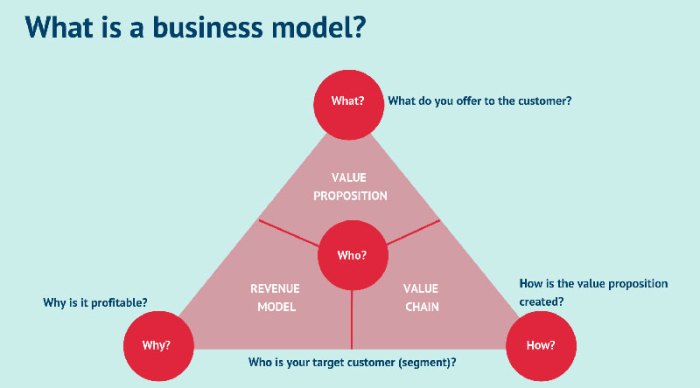
Developing innovative business models requires a strategic approach that blends creativity, market analysis, and a deep understanding of customer needs. This process involves identifying unmet needs, exploring new technologies, and reimagining existing value propositions within a chosen industry. Let’s explore this process further using the sustainable fashion industry as our example.
Brainstorming new business models necessitates a thorough understanding of the current market landscape and identifying potential areas for disruption. This includes analyzing existing business models, pinpointing their weaknesses, and exploring opportunities for improvement or completely new approaches. For the sustainable fashion industry, this could involve examining the challenges of sourcing sustainable materials, reducing waste, and appealing to environmentally conscious consumers.
Business Model Canvas Comparison: Sustainable Fashion
The following table compares three different business model canvases for companies operating in the sustainable fashion industry. Each canvas represents a distinct approach to delivering value and achieving profitability within the context of sustainability.
| Value Proposition | Customer Segments | Channels | Customer Relationships | Revenue Streams | Key Activities | Key Resources | Key Partnerships | Cost Structure |
|---|---|---|---|---|---|---|---|---|
| High-quality, ethically sourced clothing with minimal environmental impact. | Environmentally conscious consumers willing to pay a premium for sustainable products. | Direct-to-consumer e-commerce website, pop-up shops, collaborations with sustainable retailers. | Personalized customer service, online community building, transparent communication about sourcing and production. | Direct sales of clothing, subscription boxes, upcycling services. | Sourcing sustainable materials, ethical manufacturing, marketing and sales, customer service. | Sustainable materials, ethical manufacturing partners, e-commerce platform, brand reputation. | Sustainable material suppliers, ethical manufacturers, logistics providers. | Material costs, manufacturing costs, marketing and advertising, customer service, technology infrastructure. |
| Affordable, sustainable clothing made from recycled materials. | Price-sensitive consumers interested in sustainable options. | Online marketplaces (e.g., Etsy, Amazon), partnerships with thrift stores. | Automated customer service, social media engagement. | Direct sales of clothing, commissions from online marketplaces. | Sourcing recycled materials, efficient manufacturing, online sales management. | Recycled materials, manufacturing equipment, online sales channels. | Recycled material suppliers, manufacturers, online marketplaces. | Material costs (potentially lower due to recycled materials), manufacturing costs, online marketplace fees. |
| Clothing rental subscription service featuring sustainable brands. | Consumers seeking variety and affordability, reducing clothing waste. | Subscription website, mobile app, partnerships with fashion stylists. | Personalized style recommendations, convenient pick-up and delivery services. | Monthly subscription fees, potential upselling of accessories. | Sourcing sustainable clothing, logistics management, customer service, cleaning and maintenance. | Sustainable clothing inventory, logistics network, technology platform, stylist network. | Sustainable fashion brands, logistics providers, dry cleaning services. | Clothing acquisition costs, logistics costs, cleaning and maintenance costs, technology infrastructure. |
Challenges and Opportunities of Implementing New Business Models
Implementing new business models, particularly in a rapidly evolving industry like sustainable fashion, presents both significant challenges and exciting opportunities. Success hinges on careful planning, adaptability, and a strong understanding of the target market.
Challenges can include securing sufficient funding to support initial investments in sustainable materials and technologies, establishing strong supply chains that prioritize ethical and environmental considerations, and educating consumers about the value proposition of sustainable fashion. Furthermore, competition from established brands and the need to balance profitability with sustainability goals present ongoing hurdles.
Opportunities, however, abound. Growing consumer demand for sustainable products creates a significant market for innovative business models. Technological advancements, such as improved recycling technologies and innovative sustainable materials, offer avenues for cost reduction and enhanced product quality. Building strong brand loyalty through transparent communication and community engagement can also foster long-term success. Finally, leveraging digital channels for direct-to-consumer sales and efficient logistics can streamline operations and reduce environmental impact.
Implementing Business Model Innovation
Successfully transitioning to a new business model requires careful planning and execution. This involves not only the technical aspects of the model itself but also effective communication and ongoing monitoring to ensure its viability and success. A phased approach, coupled with proactive risk management, is crucial for a smooth implementation.
Step-by-Step Implementation Guide
Implementing a new business model is a multi-stage process. A structured approach minimizes disruption and maximizes the chances of success. The following steps provide a framework for this process.
- Pilot Program: Begin with a small-scale pilot program to test the new model in a controlled environment. This allows for identifying and addressing potential flaws before a full-scale launch. For example, a company launching a subscription service might initially offer it to a select group of loyal customers.
- Phased Rollout: Gradually expand the implementation, monitoring key performance indicators at each stage. This allows for adjustments based on real-world data and feedback. A phased rollout minimizes the impact of any unforeseen issues.
- Resource Allocation: Allocate sufficient resources, including personnel, budget, and technology, to support the implementation. This ensures that the new model has the necessary support to succeed. Under-resourcing can lead to delays and ultimately failure.
- Training and Development: Invest in training and development for employees to ensure they understand and can effectively execute the new business model. This is crucial for buy-in and successful adoption across the organization.
- Continuous Monitoring and Adjustment: Continuously monitor key performance indicators (KPIs) and make necessary adjustments to the model based on performance data and market feedback. This iterative approach is essential for adapting to changing circumstances.
Risk Mitigation Strategies
Implementing a new business model inherently involves risks. Proactive risk mitigation strategies are essential to minimize potential negative impacts.
- Thorough Due Diligence: Conduct thorough market research and competitive analysis to identify potential challenges and opportunities. This helps in proactively addressing potential problems before they arise.
- Contingency Planning: Develop contingency plans to address potential setbacks. This includes having backup strategies in case of unexpected events, such as a competitor launching a similar product or a sudden shift in market demand.
- Financial Buffer: Maintain a financial buffer to absorb potential losses during the initial stages of implementation. This provides a safety net in case the new model takes longer than expected to generate revenue.
- Scalability Assessment: Assess the scalability of the new business model to ensure it can handle growth without significant challenges. This involves analyzing the infrastructure, processes, and resources required to support expansion.
Stakeholder Communication Plan
Effective communication is crucial for successful business model innovation. A well-defined communication plan ensures that all stakeholders are informed and aligned.
A multi-faceted approach is needed. Internal communication should focus on employee training and engagement, emphasizing the benefits of the new model and addressing any concerns. External communication should target customers, highlighting the value proposition of the new model and building anticipation for its launch. Investor communication should focus on the financial implications and potential return on investment.
Key Performance Indicators (KPIs)
Monitoring KPIs is vital for tracking the success of the new business model. These metrics provide valuable insights into performance and guide necessary adjustments.
| KPI | Description | Target |
|---|---|---|
| Customer Acquisition Cost (CAC) | The cost of acquiring a new customer. | Reduce CAC by 15% within six months. |
| Customer Lifetime Value (CLTV) | The predicted revenue generated by a single customer over their relationship with the business. | Increase CLTV by 20% within one year. |
| Customer Churn Rate | The percentage of customers who stop using the product or service. | Reduce churn rate by 10% within three months. |
| Revenue Growth | The percentage increase in revenue. | Achieve 25% revenue growth within the first year. |
| Return on Investment (ROI) | The return on investment made in the new business model. | Achieve a positive ROI within two years. |
Business Model Innovation and Related Concepts
Business model innovation is intrinsically linked to broader business development strategies, impacting growth, profitability, and market positioning. It’s not simply about tweaking existing processes; it’s about fundamentally rethinking how value is created, delivered, and captured. This section explores the relationship between business model innovation and several key business concepts.
Business Model Innovation and Business Development
Business model innovation is a crucial driver of business development. Successful business development often hinges on adapting to changing market conditions, technological advancements, and evolving customer needs. For example, Netflix’s shift from a DVD rental service to a streaming platform exemplifies business model innovation driving significant business development. This change allowed them to reach a vastly larger audience and create new revenue streams, ultimately transforming the entertainment industry.
Conversely, Kodak’s failure to adapt its business model to the rise of digital photography led to its decline, highlighting the importance of proactive business model innovation in sustained business development.
Ethical Considerations in Business Model Innovation
Business ethics play a vital role in shaping the responsible implementation of new business models. Consideration should be given to environmental sustainability, fair labor practices, data privacy, and consumer protection. For instance, a company innovating in the sharing economy must carefully address issues like worker classification and liability. Conversely, a company focused on sustainable practices might build its business model around reducing its carbon footprint, attracting environmentally conscious customers.
The ethical implications must be carefully evaluated and integrated into the design and implementation of any new business model.
Business Coaching and Business Model Implementation
Business coaching provides invaluable support during business model implementation. Coaches offer guidance, challenge assumptions, and help navigate the complexities of change management. They can facilitate strategic planning, team building, and effective communication, essential components for a successful transition. A coach can help a business identify potential roadblocks, develop contingency plans, and ensure the new model aligns with the overall business strategy.
This support is especially crucial during the initial stages of implementation, when uncertainty and resistance are common.
Business Loans and Business Model Innovation
Business loans can provide the necessary capital to fund business model innovation. Securing financing can be crucial for investing in new technologies, expanding operations, or marketing a new product or service. However, it’s vital to demonstrate the viability and potential return on investment of the proposed business model to secure funding. A well-defined business plan outlining the innovative aspects, market analysis, and financial projections is essential in securing a loan for business model transformation.
Government grants and venture capital can also be viable sources of funding.
Business Model and Business Strategy Interplay
A business model is an integral part of a broader business strategy. The business model defineshow* the strategy will be executed, detailing the value proposition, target market, revenue streams, and key resources. The business strategy, on the other hand, Artikels the overall goals and objectives, providing the context for the business model. For example, a business strategy focused on market leadership might employ a business model emphasizing aggressive growth and market penetration.
A strategy focused on sustainability might employ a business model prioritizing environmentally friendly practices. Both elements are interdependent and must be aligned for overall success.
Business Travel and Business Model Innovation
Business travel plays a significant role in the development and implementation of business model innovation. Face-to-face meetings with clients, partners, and industry experts facilitate knowledge sharing, collaboration, and the gathering of crucial market insights. International travel can expose businesses to diverse markets and innovative approaches, fostering cross-cultural understanding and stimulating creativity. For example, attending industry conferences or visiting potential manufacturing partners can directly inform the development of a new business model, accelerating the innovation process.
Fictional Scenario: GreenTech Solutions
GreenTech Solutions, a small startup, initially offered basic solar panel installation services. However, recognizing the limitations of a solely installation-based model, they innovated by incorporating energy monitoring and predictive maintenance into their offerings. This involved developing a sophisticated software platform that tracks energy consumption, predicts potential system failures, and proactively schedules maintenance.
GreenTech Solutions’ business model shifted from a transactional, one-time service to a subscription-based model, generating recurring revenue and fostering stronger customer relationships. The challenges included the high initial investment in software development and the need to educate customers about the benefits of the new service. They overcame these challenges through strategic partnerships with investors and a targeted marketing campaign highlighting the cost savings and increased reliability offered by their new platform.
Mastering business model innovation requires a strategic blend of analysis, creativity, and execution. By understanding the core components of a successful model, employing robust analytical frameworks, and developing a clear implementation plan, businesses can unlock new avenues for growth and sustainability. This journey, though challenging, offers immense rewards for those willing to embrace change and adapt to the dynamic demands of the modern market.
The ability to continuously innovate and refine your business model is the key to long-term success in an ever-evolving landscape.
FAQ Guide
What is the difference between business model innovation and product innovation?
Product innovation focuses on creating new or improved products or services. Business model innovation, however, focuses on changing how a company creates, delivers, and captures value, often involving changes to the entire business model.
How can I identify opportunities for business model innovation in my company?
Start by analyzing your current business model, identifying weaknesses and areas for improvement. Look for unmet customer needs, emerging technologies, and changes in the competitive landscape that could be leveraged to create a more efficient or effective model.
What are some common pitfalls to avoid when implementing a new business model?
Common pitfalls include underestimating the resources required, failing to adequately communicate the changes to stakeholders, and not properly monitoring key performance indicators (KPIs) to track progress and make necessary adjustments.
How long does it typically take to implement a new business model?
The timeframe varies significantly depending on the complexity of the changes, the size of the organization, and the resources available. Some changes may be implemented quickly, while others may take years.


