Effective business strategies are the bedrock of organizational success, guiding companies toward sustainable growth and market dominance. This exploration delves into diverse examples, showcasing how strategic planning across various industries tackles unique challenges and drives remarkable results. We will examine established frameworks, analyze real-world case studies, and even construct a strategy for a hypothetical startup, providing a comprehensive understanding of strategic decision-making.
From analyzing Porter’s Five Forces to developing a marketing plan for a sustainable energy company, we’ll cover the crucial steps involved in creating and implementing a winning strategy. We’ll also explore the interplay between business strategy and other essential business functions, including business development, ethical considerations, and the role of business loans and coaching in achieving strategic goals. This detailed examination aims to equip readers with a practical understanding of how to develop and implement effective business strategies.
Defining Business Strategy
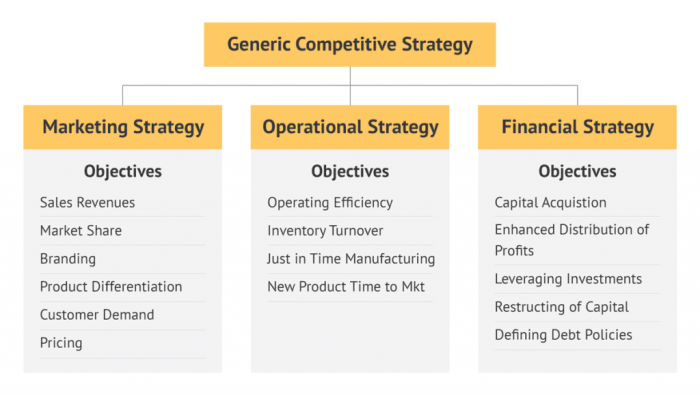
A business strategy is a long-term plan that Artikels how a company will achieve its goals and objectives. It’s a roadmap that guides decision-making across all aspects of the business, from product development and marketing to operations and finance. A successful business strategy isn’t just a document; it’s a living, breathing entity that adapts to the ever-changing market landscape.Core components of a successful business strategy include a clear definition of the target market, a competitive advantage, a well-defined value proposition, and a robust implementation plan.
These elements work together to create a cohesive and effective plan for growth and sustainability. Without a clear understanding of these components, a business risks aimless wandering and ultimately, failure.
Core Components of a Business Strategy
A successful business strategy hinges on several key components. Firstly, understanding the target market is crucial. Knowing who your customers are, their needs, and their preferences allows for targeted marketing and product development. Secondly, a sustainable competitive advantage is paramount. This could be through lower costs, superior product quality, innovative technology, or strong brand recognition.
Thirdly, a compelling value proposition clearly articulates the benefits your product or service offers to customers. Finally, a comprehensive implementation plan Artikels the steps needed to execute the strategy, assigning responsibilities and setting timelines.
Business Strategy Frameworks
Several frameworks can assist in developing and analyzing a business strategy. Porter’s Five Forces, for example, helps analyze the competitive intensity of an industry by examining the threat of new entrants, the bargaining power of suppliers and buyers, the threat of substitute products or services, and the rivalry among existing competitors. A high score across these factors indicates a highly competitive and potentially less profitable industry.
SWOT analysis (Strengths, Weaknesses, Opportunities, Threats) provides a structured approach to evaluating internal capabilities and external factors that could impact the business. This framework allows for a balanced view, identifying areas of strength to leverage and weaknesses to mitigate, while considering external opportunities and threats. These analyses are crucial for informed decision-making.
Developing a Comprehensive Business Strategy
Developing a comprehensive business strategy involves several key steps. First, define the company’s mission, vision, and values. These statements serve as the foundation for all strategic decisions. Next, conduct a thorough market analysis to identify opportunities and threats. This involves analyzing market trends, customer preferences, and competitive landscape.
Following this, a competitive analysis should be conducted to identify strengths and weaknesses relative to competitors. Based on this analysis, a competitive advantage should be defined and a value proposition developed. Then, specific goals and objectives should be established, with measurable targets and timelines. Finally, a detailed implementation plan, including resource allocation and responsibility assignments, should be created and regularly monitored and adjusted as needed.
This iterative process ensures the strategy remains relevant and effective.
Business Strategy Examples Across Industries
Successful businesses often leverage well-defined strategies to achieve their goals and overcome challenges. Analyzing successful strategies across diverse industries provides valuable insights into effective approaches to market positioning, resource allocation, and competitive advantage. This section examines three distinct examples, highlighting their unique approaches and common threads.
Successful Business Strategies Across Diverse Industries
The following table showcases three successful business strategies from different industries, detailing the challenges faced, the strategies implemented, and the resulting outcomes. Each example demonstrates a different approach to achieving sustainable competitive advantage.
| Industry | Company | Strategy | Results |
|---|---|---|---|
| Technology | Apple | Focus on a seamless ecosystem of hardware, software, and services; premium pricing strategy; strong brand building and customer loyalty; innovative product design. | Dominant market share in smartphones, tablets, and computers; high profit margins; strong brand recognition and customer loyalty; creation of a highly valuable ecosystem. |
| Retail | Amazon | Customer-centric approach prioritizing convenience and speed; aggressive expansion into new markets and product categories; data-driven decision-making; efficient logistics and supply chain management; emphasis on online sales and personalized experiences. | Global e-commerce dominance; significant market share in cloud computing (AWS); vast customer base; innovative fulfillment and delivery systems; continuous expansion and diversification. |
| Healthcare | Johnson & Johnson | Diversification across various healthcare sectors (pharmaceuticals, medical devices, consumer health); strong research and development; focus on quality and safety; global presence and strategic acquisitions. | Leading position in multiple healthcare segments; strong brand reputation; significant revenue and market capitalization; consistent growth and innovation across diverse product lines. |
Challenges Faced and Strategic Responses
Each company faced unique challenges. Apple initially faced competition from established PC manufacturers and later from Android-based smartphones. Their strategy of creating a tightly integrated ecosystem and emphasizing user experience allowed them to overcome this. Amazon faced challenges in scaling its operations to meet growing demand and maintaining profitability amidst intense competition. Their data-driven approach and efficient logistics helped them address these issues.
Johnson & Johnson navigated regulatory hurdles and evolving healthcare landscapes. Their diversification strategy mitigated risks associated with individual market segments and ensured long-term sustainability.
Comparison and Contrast of Strategies
While each strategy is unique, several common threads emerge. All three companies prioritize customer experience, invest heavily in research and development, and leverage data to inform decision-making. However, their approaches differ in terms of focus. Apple emphasizes premium branding and a tightly controlled ecosystem. Amazon focuses on scale, convenience, and data-driven personalization.
Johnson & Johnson emphasizes diversification and long-term sustainability across multiple healthcare segments. These differing strategies highlight the diverse paths to success, tailored to the specific industry and competitive landscape.
Analyzing Business Strategy Case Studies
Analyzing business strategy case studies provides invaluable insights into the decision-making processes of successful and unsuccessful companies. By examining real-world examples, we can learn to identify effective strategies, understand the impact of various market forces, and improve our own strategic thinking. This analysis helps to bridge the gap between theoretical frameworks and practical application.
Netflix’s Transition to Streaming: A Case Study in Strategic Adaptation
Netflix initially operated as a DVD-rental-by-mail service. Facing increasing competition from streaming services and evolving consumer preferences, Netflix successfully transitioned its business model to become a dominant player in the streaming video market. Their market analysis identified a growing demand for on-demand, easily accessible digital content. The competitive landscape included established players like Blockbuster (which ultimately failed to adapt) and emerging competitors like Hulu and Amazon Prime Video.
Netflix’s chosen strategy involved significant investment in original content creation, a robust recommendation algorithm, and a global expansion strategy.
Factors Contributing to Netflix’s Success
Several key factors contributed to Netflix’s success. Firstly, their early adoption of streaming technology gave them a first-mover advantage. Secondly, their substantial investment in original programming, including critically acclaimed series like “House of Cards” and “Stranger Things,” differentiated them from competitors. Thirdly, their data-driven approach to content recommendation personalized the user experience and increased engagement. Finally, their global expansion strategy tapped into a vast and growing international market.
Impact on Financial Performance and Market Position
Netflix’s strategic shift dramatically impacted its financial performance. While the transition involved significant upfront costs, it ultimately led to substantial revenue growth and increased profitability. Their market position transformed from a niche DVD rental service to a global leader in streaming entertainment, commanding a significant market share and high brand recognition. This success can be attributed to their proactive adaptation to changing market dynamics and their bold investment in a new business model.
The Interplay of Business Strategy with Other Business Functions
A successful business strategy doesn’t exist in isolation; it’s deeply intertwined with various other business functions. Effective implementation requires a holistic approach, recognizing the interconnectedness of strategy with areas like business development, ethics, coaching, finance, and even travel. Understanding these relationships is crucial for achieving strategic objectives and fostering sustainable growth.
Business Strategy and Business Development
Strategic planning directly fuels business growth initiatives. For example, a company aiming for market expansion (a strategic goal) might utilize business development activities such as market research, identifying potential partnerships, and developing new product lines. The strategic plan provides the roadmap, defining target markets, resource allocation, and key performance indicators (KPIs) to measure progress. A clear strategy ensures that business development efforts are focused and efficient, avoiding wasted resources on initiatives that don’t align with overall objectives.
For instance, a tech startup with a strategy focused on rapid scaling might prioritize securing venture capital funding and building strategic partnerships to accelerate growth, while a mature company focused on sustainable profitability might concentrate on organic growth through improved customer retention and operational efficiencies.
Ethical Considerations in Implementing a Business Strategy
Ethical considerations are paramount in strategic implementation. Ethical dilemmas can arise in various aspects, such as prioritizing profit maximization over employee well-being, engaging in questionable marketing practices, or compromising environmental sustainability for short-term gains. Resolving these dilemmas often requires careful consideration of stakeholder interests, adherence to legal and regulatory frameworks, and a commitment to ethical business practices. For example, a company facing pressure to cut costs might choose to reduce executive compensation rather than laying off employees, prioritizing ethical treatment of its workforce.
Alternatively, a company developing a new product might invest in rigorous safety testing, even if it increases development costs, to avoid potential harm to consumers.
Business Coaching and Enhanced Strategy Effectiveness
Business coaching plays a vital role in enhancing the effectiveness of a business strategy. Coaches provide guidance, support, and accountability to leaders and teams, helping them overcome obstacles and achieve strategic goals. Techniques such as goal setting, performance feedback, and skill development are employed to empower individuals and teams to execute the strategy effectively. For example, a coach might work with a sales team to improve their selling skills and achieve higher sales targets, a key element of a growth strategy.
Or, a coach might help a CEO develop better decision-making skills to navigate complex strategic challenges.
Business Loans and Funding Strategic Initiatives
Business loans provide the financial resources necessary to fund strategic initiatives. Different loan types, such as term loans, lines of credit, and SBA loans, cater to various needs and strategic goals. A company pursuing a large-scale expansion might secure a term loan to finance new facilities, while a small business aiming for improved operational efficiency might utilize a line of credit to purchase new equipment.
The choice of loan type depends on the strategic objective, the company’s financial health, and the repayment terms.
Comparison of Business Models and Strategic Alignment
Different business models, such as subscription-based, freemium, or franchise models, are suited to different strategies. A subscription-based model might align with a strategy focused on recurring revenue and customer retention, while a freemium model might support a strategy focused on rapid user acquisition and subsequent monetization. A franchise model might be suitable for a strategy focused on rapid expansion and market penetration.
The choice of business model needs to be carefully considered and aligned with the overall strategic goals of the company.
Impact of Business Travel on Strategy Implementation
Business travel often plays a crucial role in implementing and achieving strategic objectives. Face-to-face meetings with clients, partners, and employees can strengthen relationships, facilitate collaboration, and accelerate project completion. For example, a company negotiating a major partnership might find that in-person meetings are essential to build trust and reach a successful agreement. Similarly, attending industry conferences can provide valuable insights and networking opportunities that contribute to strategic decision-making.
Effective management of business travel is important to maximize its strategic impact while minimizing costs and disruptions.
Ultimately, the effectiveness of any business strategy hinges on a thorough understanding of the market, a clear identification of the target audience, and a robust plan to navigate competitive pressures. By studying successful strategies across diverse industries and analyzing case studies, we can glean invaluable insights into best practices and common pitfalls. This knowledge, combined with a willingness to adapt and innovate, forms the foundation for creating a winning business strategy that drives sustainable growth and long-term success.
The examples presented here serve not just as illustrations but as a springboard for developing your own impactful strategic plans.
Helpful Answers
What is the difference between a business strategy and a business plan?
A business strategy Artikels the long-term goals and overall approach to achieving them, while a business plan details the specific actions and resources needed to execute that strategy.
How often should a business strategy be reviewed and updated?
Ideally, a business strategy should be reviewed and updated at least annually, or more frequently if the market or competitive landscape changes significantly.
What are some common mistakes companies make when developing their business strategies?
Common mistakes include failing to conduct thorough market research, underestimating competition, lacking a clear understanding of the target market, and setting unrealistic goals.
How can a small business effectively implement a business strategy?
Small businesses can start by focusing on a clear, concise strategy, prioritizing key objectives, and utilizing available resources efficiently. They should also be flexible and adapt their strategy as needed.